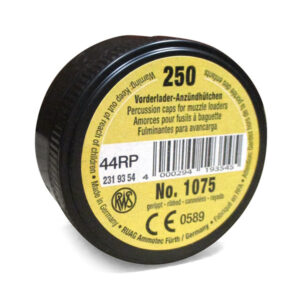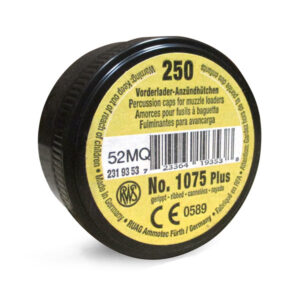
Percussion Caps & musket caps
Percussion caps can be thought of as a predecessor to the modern primers that we are familiar with today. These ignition sources require a flat hammer or broad firing pin strike rather than a pointed firing pin to ignite, and they work by being crushed between a percussion cap nipple and the hammer or firing pin.
The three main sizes of percussion caps are #10 percussion, #11 percussion, and musket caps.
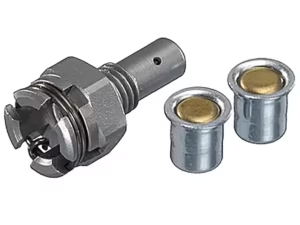
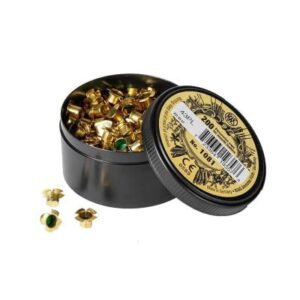
Many people often believe that the terms “percussion cap” and “musket cap” are interchangeable, however, this is not the case. Percussion caps are a general category of muzzleloader ignition and musket caps fall under that category. All musket caps are percussion caps, however, not all percussion caps are musket caps. Musket caps are their own unique size and are bigger and hotter than #11 percussion caps. Below are some photos with side-by-side comparisons to visual the differences.
On the left you can see musket caps and the on the right you can see #11 percussion caps.

Typically, #10 percussion caps are used in black powder revolvers and small pistols such as derringers. Larger caliber single shot pistols and traditional sidelock rifles you will primarily require a #11 percussion cap. In some cases, a traditional side lock muzzleloader will use a musket caps and is typically seen on historical guns such as the 1861 Springfield. As mentioned above, select inline muzzleloader models will use a musket cap ignition that are designed for hunting in Oregon and Idaho. While the aforementioned generalizations are fairly accurate, you will want to make sure you know which percussion cap your muzzleloader needs by checking the user manual for the gun.
Pelletized powder does require a hotter ignition than what most caps can offer, so it is recommended to only use pelletized powder with a 209 magnum ignition. Loose powder such as Pyrodex, Triple 7, and true black powder is highly recommended to use with a percussion cap ignition.
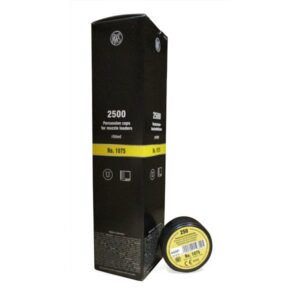
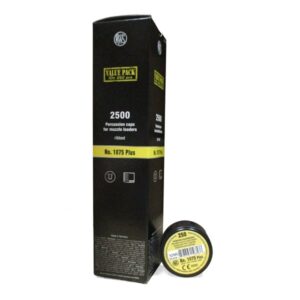
The brands we recommend for percussion caps are listed below:
| RWS | CCI | Schuetzen |
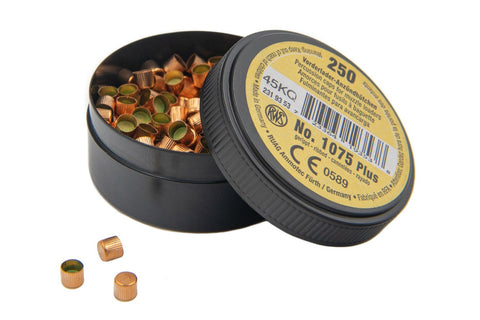 | 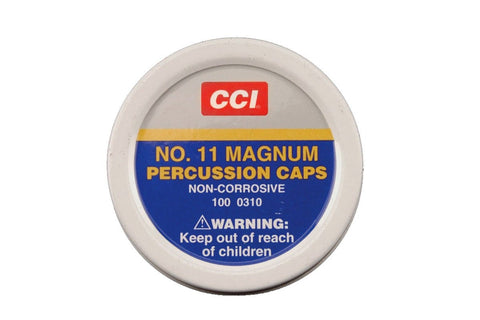 | 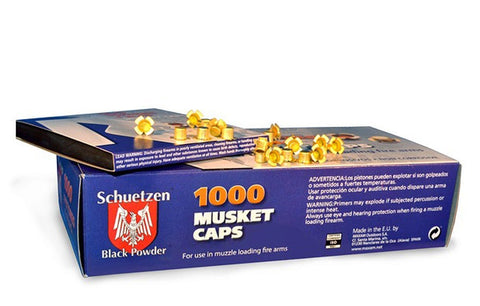 |
All three brands produce a variety of percussion caps and they all work well. Overall, we personally recommend RWS as the best percussion cap manufacturer. They make very reliable caps that have proven to be the most consistent across the variety of muzzleloaders that we carry.
Keep in mind that Traditions Northwest ignition muzzleloaders are not rated to use Schuetzen musket caps, so it is recommended to primarily use RWS 1081 musket caps in those particular muzzleloaders.
-
 Price range: $21.99 through $464.99Select options This product has multiple variants. The options may be chosen on the product page
 -
 Price range: $89.99 through $459.99Select options This product has multiple variants. The options may be chosen on the product page